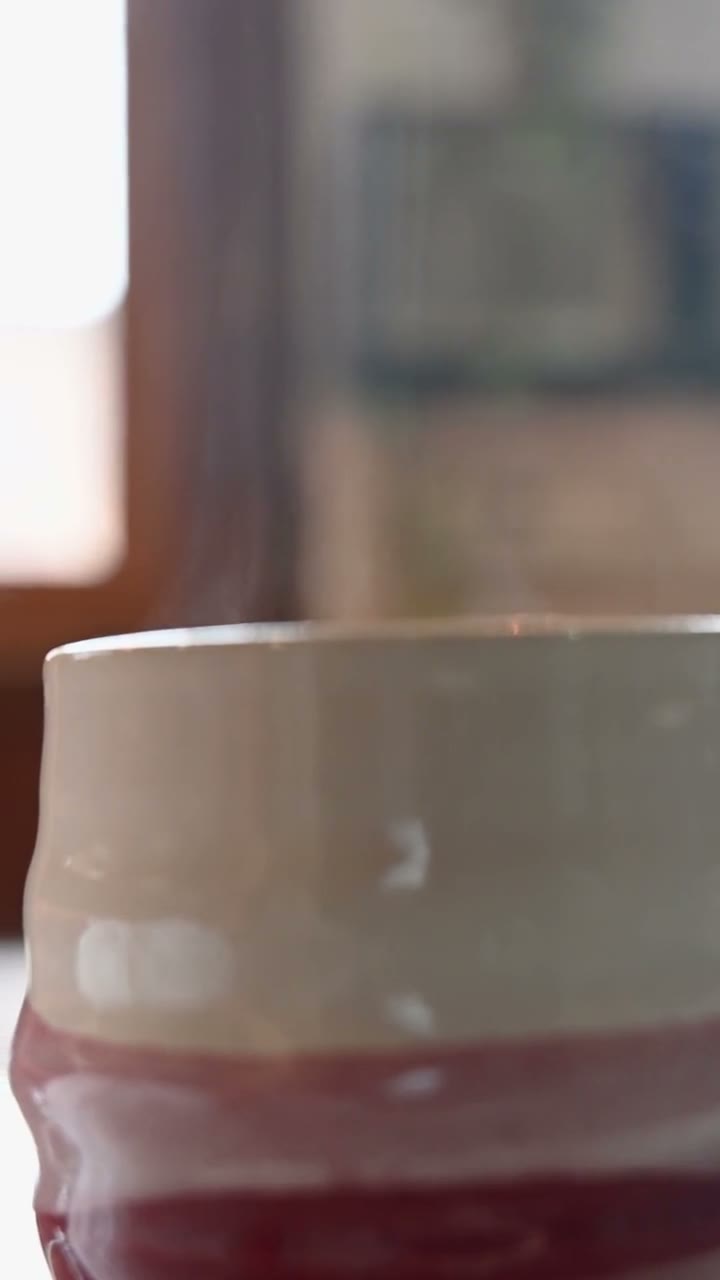
The cup warms your hands. Steam rises. For a moment, coffee is simply part of your morning.
But this small ritual rests on years of growing, a harvest, and work that has almost disappeared from view. Follow the story backward, while the cup is still warm.
Scroll to follow it backward.
A familiar ritual. Film by Miriam Alonso.
At the roastery
The aroma came late.
The smell we associate with coffee develops during roasting. Heat transforms green seeds into the aromatic brown beans we recognize.
We usually encounter coffee after this transformation. It is easy to mistake that familiar appearance for how it began.
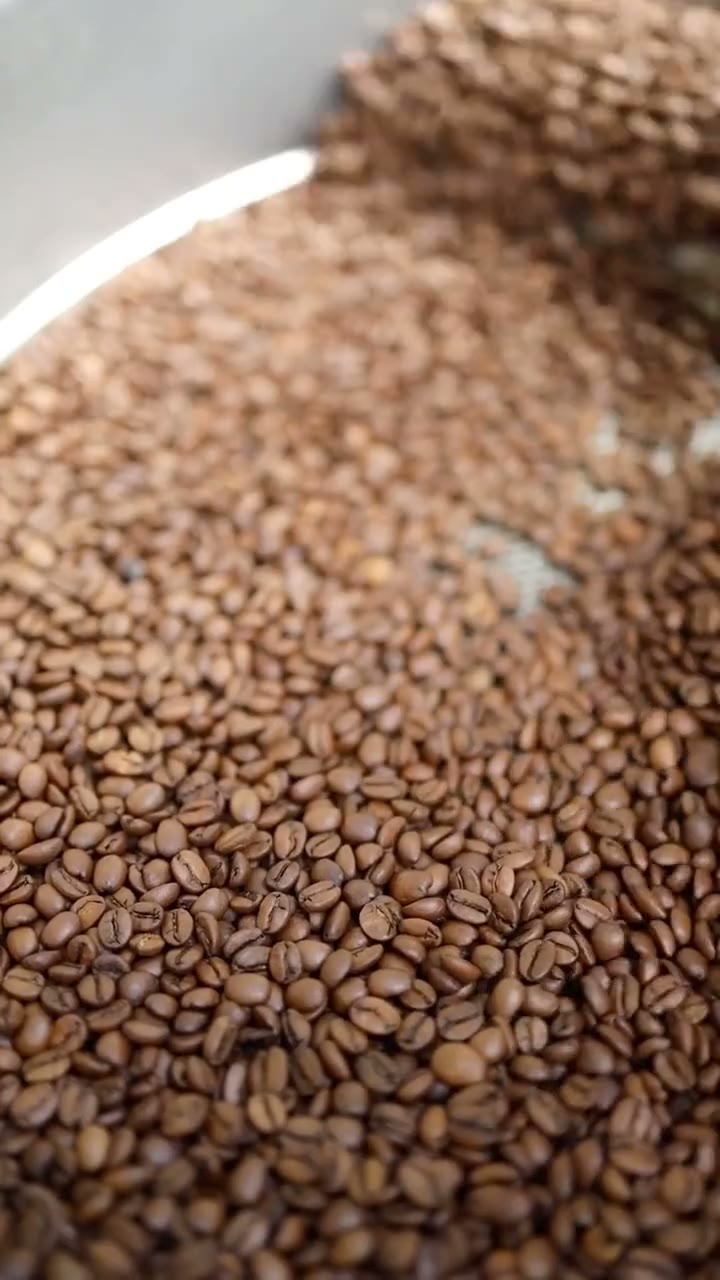
About roasting ↗At the roastery: roasted beans in a cooling tray. Film by Maksim Goncharenok.
Green coffee
This is coffee, too.
Before roasting, the seed is green. The familiar brown color is still ahead of it.
This is the form we will follow beyond the roastery: coffee packed as cargo, with much of its journey already behind it.
Green coffee: an unroasted seed. Original illustration.
Peru → California · 2014
One shipment leaves a trail.
In 2014, coffee from Peru’s Casil cooperative traveled to Cafe Moto in San Diego. The shipment’s recorded stops let us retrace its passage—from a California waterfront back toward the people who grew it.
Casil’s farmers harvested this lot for one roaster. Now widen the view: the seed in front of us belongs to a much larger shipment.
Green, unroasted coffee.
Between two shores / 02
Packed for the crossing.
At the dry mill, workers loaded the bagged coffee into a shipping container. Packing was part of protecting the harvest through the journey ahead.
A sack of green coffee, illustrated in cutaway.
Between two shores / 03
Even the lining mattered.
Corrugated cardboard lined the container, helping protect the coffee against condensation as the ship traveled from warmer Peruvian waters toward cooler North America.
INSIDE THE CONTAINER
Corrugated cardboard lining
Coffee sacks inside a cardboard-lined container.
THE BEAN BECOMES A SHIPMENT02
Oakland
September 26, 2014
San Diego
Cafe Moto · destination
Balboa, Panama
Pacific port · 19-day wait
Paita, Peru
August 23, 2014
Frontera dry mill
Inland placement approximate
Route traced backward
Schematic route
Oakland
September 26, 2014
San Diego
Cafe Moto · destination
Balboa, Panama
Pacific port · 19-day wait
Paita, Peru
August 23, 2014
Frontera dry mill
Inland placement approximate
Route traced backward
Schematic route
Following the route backward / 04
Arrival was another handoff.
From Oakland, the coffee went into warehouse storage. Cafe Moto collected it as needed for its San Diego roastery. Arrival in California was still a step away from roasting.
Oakland · September 26, 2014
Following the route backward / 05
Nineteen days between ships.
At Balboa, the coffee was unloaded and waited for clearance to continue. Nineteen days passed before it departed aboard the next vessel.
Balboa · August 27 – September 15, 2014
19 days waiting
Following the route backward / 06
A port, and the paperwork.
The container reached Paita by truck for export processing. Only then was it loaded aboard the Kiel Trader for the first leg north.
Paita · August 23, 2014
Following the route backward / 07
Preparing a harvest for export.
At Frontera, milling and quality checks came before bagging. The coffee had arrived from Casil’s warehouse; it left ready to be packed for the sea crossing.
Frontera dry mill · August 13, 2014
And before it could travel,
someone had to grow it.
Back among the green beans, before their journey.
CALIFORNIA · PANAMA · PERU02
One shipment, traced backward
San Diego
Cafe Moto brings coffee from the warehouse to its roastery as needed.
Annex Warehouse
The coffee is unloaded and stored after its arrival in Oakland.
Oakland
The shipment arrives in California.
Balboa, Panama
19 days waiting between ships on Panama’s Pacific side.
Paita, Peru
The shipment leaves Peru aboard the Kiel Trader.
Frontera dry mill
Coffee is milled, evaluated for quality, and bagged for export. The map’s inland marker is schematic.
Casil cooperative, Peru
The shipment account begins with coffee harvested by Casil’s farmers.
INSIDE WASHED COFFEE Following the process backward
We call it a bean.
But a coffee bean is a seed. To see where it grew, we need to put back the layers removed on its way to the roastery.
A green coffee seed.
INSIDE WASHED COFFEE Following the process backward
Put back the parchment.
This protective layer surrounded the seed as the coffee dried. The dry mill removed it. Following the process backward, we restore it first.
Dried parchment coffee: the seed remains inside its protective layer.
INSIDE WASHED COFFEE Following the process backward
Rewind through the washing.
Earlier, the seed was still moist. In washed processing, workers remove the fruit’s pulp and sticky mucilage before drying. Go back further, and those layers return around the seed.
An earlier processing state, before drying.
INSIDE WASHED COFFEE Following the process backward
A fruit, with coffee inside.
Most coffee cherries hold two seeds, each inside its own parchment layer. The cargo we followed began here, enclosed in fruit on a living branch.
A simplified coffee cherry cutaway, with two seeds and their individual parchment layers.The fruit on its branch.
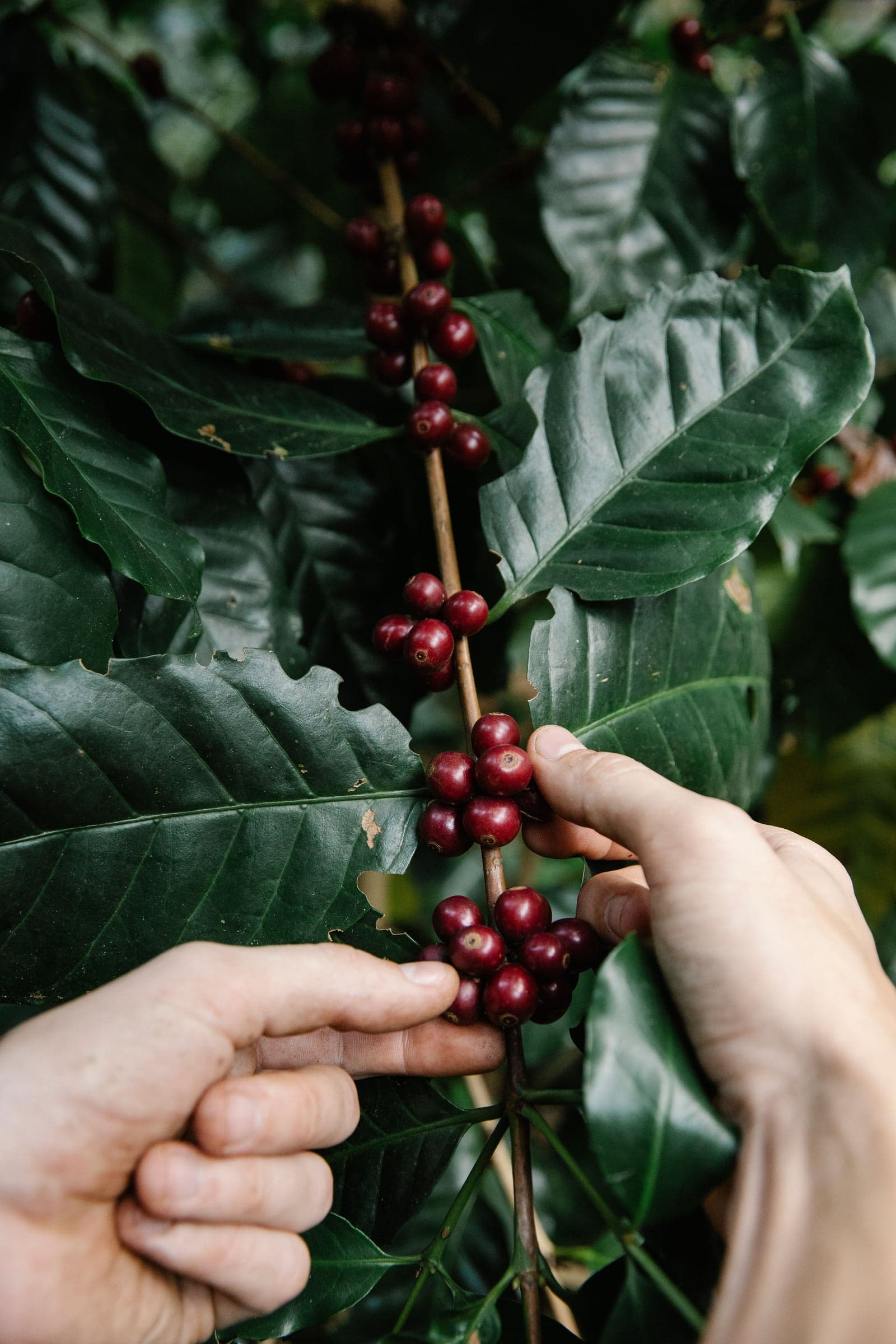
In selective harvesting, workers choose ripe cherries and leave the others to mature. Picking means returning to the trees as more fruit becomes ready.
Someone grew this / Growing time
First, there is a tree to raise.
A seedling needs watering and protection from harsh sunlight before it is ready to be planted out. Long before there is fruit to pick, there is already work to do.
3–4 years
Typically, before the first fruit, depending on the variety.
Illustrative landscape, informed by Marbin’s account.
01 / 03
Choosing the next coffee plants.
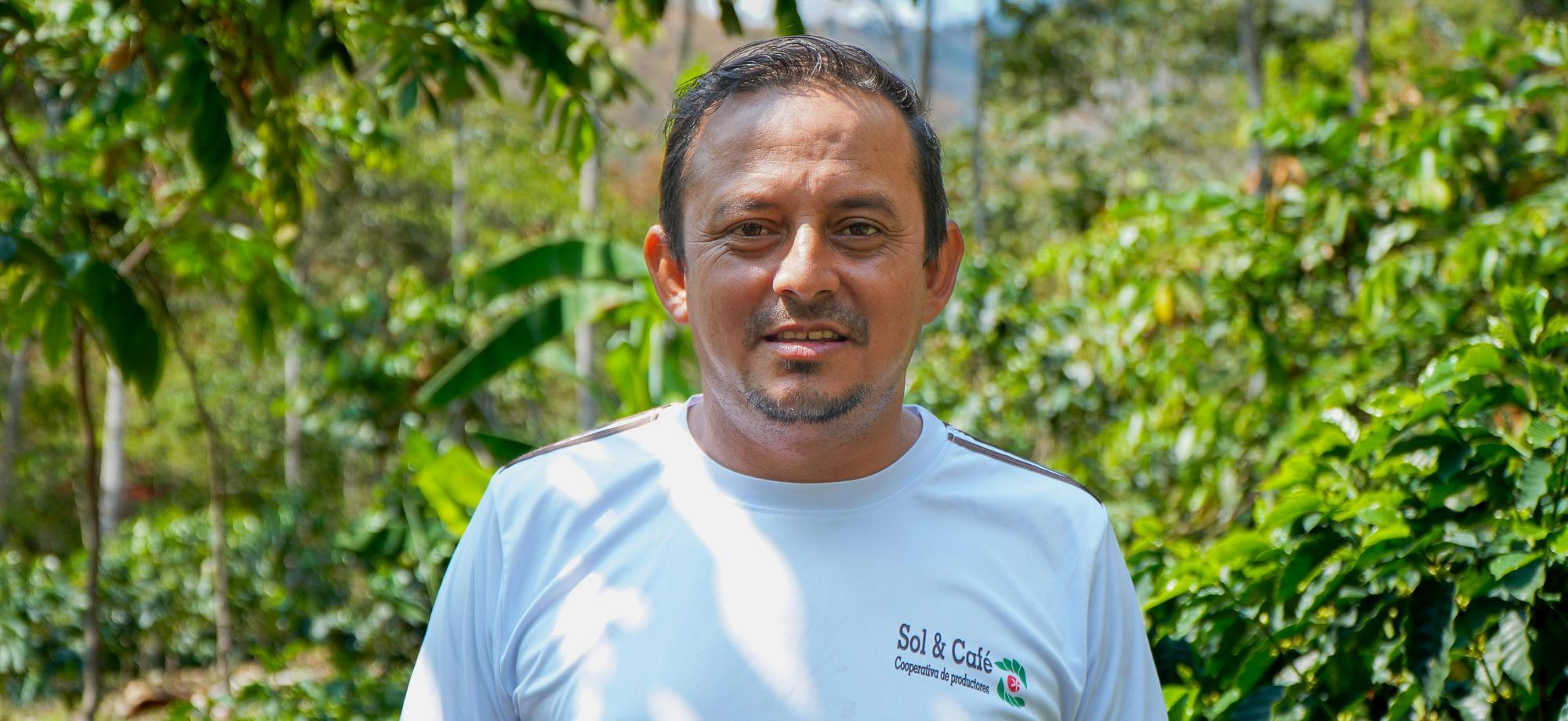
Marbin’s training helps him choose varieties that can better withstand pests. A decision about what to plant shapes the work that follows, long before the next cherries are ready.
Illustrative landscape, informed by Marbin’s account.02 / 03
Growing trees alongside the coffee.
He has also introduced agroforestry, planting trees alongside coffee. Fairtrade describes laurels and eucalyptus among them, providing shade and another potential source of income through timber or other products.
Illustrative landscape, informed by Marbin’s account.03 / 03
Planning beyond one harvest.
The aim reaches beyond the next crop: keeping the land healthy for another generation. The knowledge Marbin inherited continues to change as he puts it to work.
Illustrative landscape, informed by Marbin’s account.